As legal departments face growing demands for efficiency, transparency, and strategic alignment, the concept of “running legal like a business” has become essential.
At The Toro Company, this mindset has guided the transformation of our legal function into a more effective, data-driven, and strategically integrated operation, powered by collaboration both within and beyond the legal team.
Establishing Legal Operations: A Strategic Imperative
The Toro Company, a global leader in turf and landscape maintenance, snow and ice management, and irrigation solutions, recognized that its evolving business environment required a more sophisticated legal infrastructure.
Under the leadership of a newly appointed General Counsel, the legal department embarked on a new chapter. This included a comprehensive restructuring and the creation of a dedicated Legal Operations team to drive efficiency, innovation, and alignment with enterprise goals.
From the outset, collaboration was key. Internally, we worked across departments to align legal priorities with business strategy. Externally, we engaged with vendors and partners to modernize our approach to legal service delivery.
Laying the Foundation: Assessment and Alignment
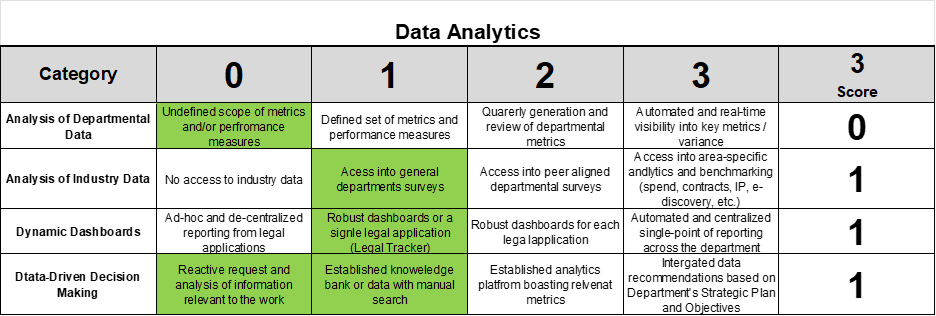
Our Legal Operations journey began with a comprehensive self-assessment using the ACC Legal Operations Maturity Model. This framework enabled us to evaluate our capabilities across critical domains, including information governance, data analytics, technology, vendor management, financial management, and strategic planning.
In parallel, we developed a self-diagnosis tool for the legal function, an internal mechanism to continuously assess maturity, performance, and alignment with business needs.
This tool has become a cornerstone of our continuous improvement efforts, reinforcing our commitment to transparency and accountability.
Financial Management: Gaining Clarity Through Structure
One of our first priorities was improving financial transparency. Previously, legal expenses for employment, contracts, real estate, international, and commercial matters were grouped under a single “Commercial” spend category, obscuring the true cost of legal services.
To address this, we partnered with our finance team to create new legal cost centers aligned with our department’s structure. This collaboration provided critical visibility into legal spend, enabling more accurate budgeting and performance tracking.
Firm and Vendor Management: Strengthening External Partnerships
Modernizing our billing guidelines was another foundational step. Our ACC Legal Operations Maturity Model analysis revealed inconsistent enforcement of existing guidelines.
In response, we set clear goals to improve compliance and accountability. We implemented a comprehensive update to the billing guidelines, trained our in-house legal team on enforcement protocols, and clearly communicated expectations to external counsel.
This initiative not only reinforced internal discipline through focused execution but also enhanced our external partnerships, demonstrating how clarity of purpose and strategic alignment can drive meaningful operational improvements.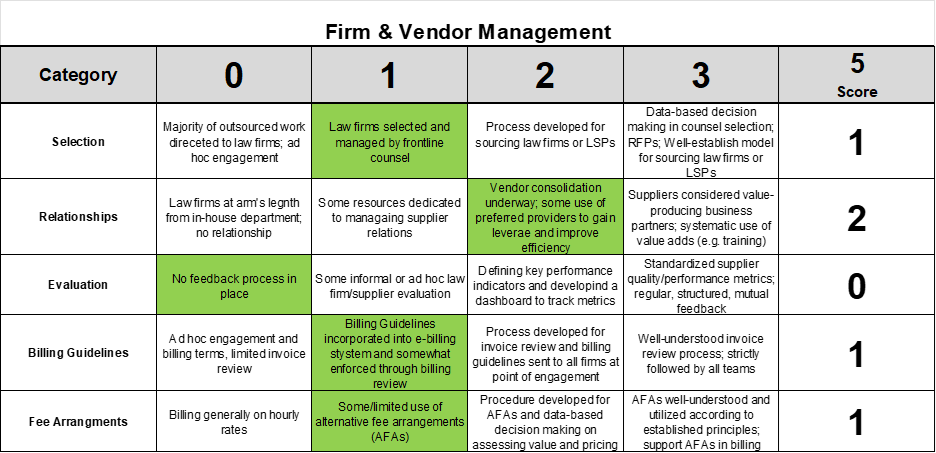
Optimizing Legal Work Allocation
We also re-evaluated our outsourcing model. For work that does not require legal advice, we now engage legal service providers instead of traditional law firms.
This shift allows us to allocate resources more efficiently while maintaining quality and responsiveness.
Though a modest change, it marked a significant cultural shift for a department that had historically relied on long-standing personal relationships with outside counsel. It reflects our shift from legacy practices to data-driven decision-making.
Data Analytics: Measuring What Matters
A central question in Legal Operations is: “What should we measure?” We focused on two key dimensions: the efficiency of internal processes and the effectiveness of legal contributions to the business.
Early on, we prioritized budget adherence and internal client satisfaction. Notably, our legal team became the first in the enterprise to conduct a Client Satisfaction Survey.
To demonstrate our responsiveness, we published an internal article titled “You Spoke, We Listened,” outlining the specific actions taken based on survey feedback. This transparent communication helped reinforce trust and highlighted the value generated by the legal team.
Strategic Focus: Aligning with Enterprise Goals
Rather than pursuing a sweeping overhaul, we adopted a phased, impact-driven approach. We prioritized initiatives that delivered measurable value with manageable effort, ensuring alignment with both departmental and enterprise-wide objectives.
At the enterprise level, we led the implementation of a company-wide e-signature platform and policy, deployed a centralized subsidiary management system and played a key role in optimizing the international dealer contract renewal process.
Within the legal department, we enhanced visibility into legal spend, developed standardized operating procedures, implemented AI technologies, initiatives that improved both transparency and operational consistency.
Crucially, these efforts were not executed in isolation. Through close collaboration with business leaders and internal stakeholders, we ensured that legal initiatives were tightly aligned with the company’s broader strategic goals.
This alignment has reinforced the legal department’s role as a proactive, value-generating partner to the business.
Leveraging Internal Expertise: A Collaborative Approach
A pivotal moment in our journey was partnering with Toro’s internal Lean team. Their expertise in continuous improvement helped us map processes, identify inefficiencies, and co-create solutions that aligned with enterprise-wide objectives.
This internal collaboration ensured that our initiatives were not only effective but also sustainable.
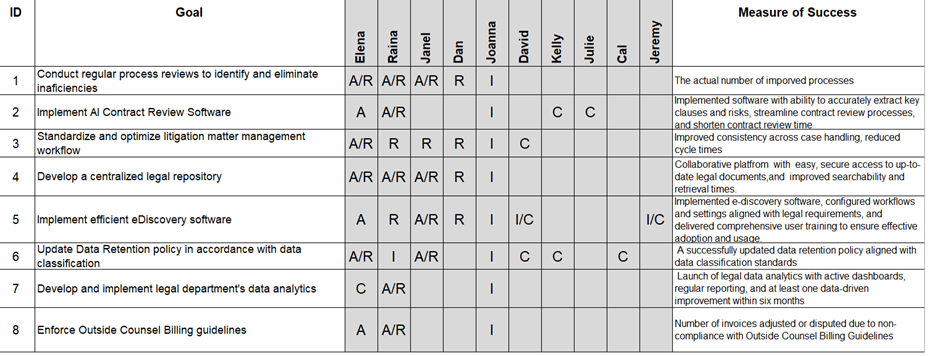
RACI is one of the key tools used by Toro Legal Operations team to plan and execute projects with clarity and accountability
Driving Change: Implementation and Measurement
With a clear roadmap in place, we launched a series of continuous improvement initiatives across the legal department. These efforts are guided by a centralized master action plan that outlines strategic priorities, key deliverables, and timelines across all legal functions.
Each area within the department, such as employment and compliance, product regulatory, product litigation, commercial, corporate secretary, and others, operates with its own strategic goals and continuous improvement plan.
Deliverables are regularly reviewed, discussed, and measured to ensure alignment with both departmental objectives and broader enterprise priorities.
Cross-functional collaboration remains essential. By engaging stakeholders across the organization, we ensure that our initiatives are practical, sustainable, and responsive to the evolving needs of the business.
Innovation in Action
Our legal transformation journey is marked by several ongoing initiatives aimed at enhancing efficiency, intelligence, and data-driven decision-making:
- Legal Hub: We are actively developing a centralized SharePoint site to serve as a one-stop resource for legal documents, intake workflows, and legal metrics, designed to streamline access, enhance collaboration, and support knowledge sharing.
- Data Integration: The integration of Power BI with our e-billing and matter management system is currently in progress, enabling real-time visibility into legal performance, spend analytics, and operational trends.
- AI Enablement: We have implemented and continue expanding the use of AI technologies to support legal drafting, contract review, and workflow automation, laying the foundation for a smarter, more scalable legal function.
We consistently measure success using defined metrics and regularly assess the maturity of our legal operations to ensure alignment with strategic objectives.
A structured maturity model guides our efforts and helps us map and prioritize initiatives effectively. We remain focused on tracking progress, refining our approach, and driving continuous improvement across all areas of legal operations.
Technology Management Maturity: 2024 to 2025 Comparison
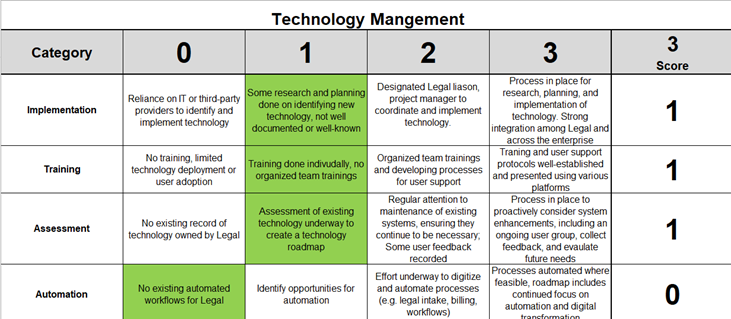
April 2024 Self-Assessment
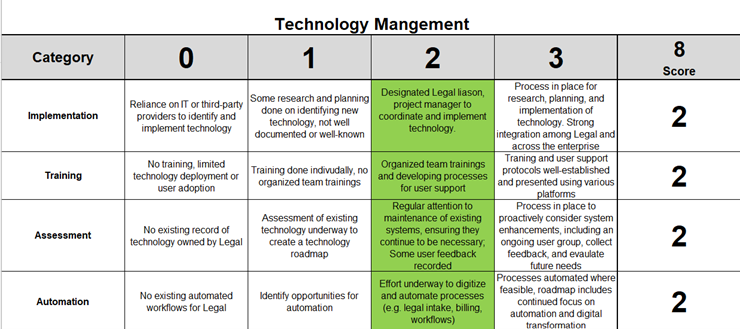
June 2025 Self-Assessment
Cultural Transformation: From Support to Strategy
Perhaps the most profound outcome of this journey has been the cultural shift within the legal department. Legal Operations is no longer viewed as a back-office function. It’s now recognized as a strategic enabler.
This transformation was made possible through sustained collaboration, internally with business partners and externally with vendors and service providers. Together, we’ve built a more proactive, data-informed, and client-focused legal culture.
We continue to focus on improving both the effectiveness and efficiency of the legal department, guided by data, feedback, and a commitment to excellence.
Reflections and Recommendations
Our experience at The Toro Company underscores a key lesson: transformation doesn’t require a massive overhaul. It begins with a clear vision, focused execution, and, most importantly, collaboration.
For organizations on a similar path, our advice is simple: start small, stay focused, and build strong partnerships. Legal Operations is a team effort, and its success lies in shared ownership, continuous learning, and strategic alignment.
As we continue to evolve, our focus remains clear: operational excellence, measurable value, and a legal team that moves at the speed of business.
About the Author:
Elena Cool holds a Master of Legal Studies degree from Capital University Law School. With over 20 years of successful experience in team leadership, program implementation, strategic planning, and execution, Elena brings a wealth of expertise to every initiative she leads. Born and raised in Russia, she also brings valuable intercultural experience, enhancing her approach to collaboration and problem-solving in diverse environments.
Currently, Elena leads the organization of the Minnesota Legal Operations Forum, a professional event that brings together legal operations professionals from across the region. This initiative reflects her commitment to giving back to the community she loves and to fostering connection, knowledge-sharing, and innovation within the legal operations field.